
Why isn’t Red Bank part of Chattanooga?
As Chattanooga expanded via annexation throughout the 1900s, some local neighborhoods evaded the city’s path. Red Bank, which became a city in 1955, was one of them.
The entire City of Chattanooga once fit into a neat rectangle next to Ross’s Landing. At its founding in 1839, Chattanooga took up the space of a few city blocks, about 2% of its current size. Decade by decade, Chattanooga grew and grew, until it reached the roughly 150 square miles it is today.
No longer compact and geometric, the city limits of today are jagged, reaching far from the river, from Soddy Daisy to Ooltewah to Rossville to Lookout Valley. Within city boundaries, there’s an unusual feature — two bubbles, carved out of city limits. Though surrounded on all sides by Chattanooga territory, the communities of Ridgeside and Red Bank are their own self-governed municipalities.
“Red Bank was incorporated in 1955,” said Red Bank Mayor Hollie Berry, “It was actually incorporated in order to prevent being incorporated by the city of Chattanooga.”
Throughout the 1900s, Chattanooga scooped up surrounding land and expanded its city limits through annexation. A 1955 state law, which empowered cities to annex land without the consent of the people living there, prompted residents in the neighborhoods of Red Bank and White Oak to try to avoid annexation by becoming a city.
About 20% of registered voters participated in the resulting referendum. It passed 2 to 1, keeping the new Red Bank-White Oak Township out of the path of its encroaching neighbor.
“And sure enough Chattanooga did continue annexing and come all the way around us,” Mayor Berry said. “So we are now surrounded 360 degrees.”
Cities may annex land to expand their tax base and get more control over development in an area. While densely populated areas tend to pay for themselves, the cost of bringing roads and sewers to places with fewer people may not be offset by new taxes.
Residents facing annexation in unincorporated areas might appreciate added city services, but on the other hand, they may oppose the city taxes that come with those services.
Mayor Berry says there can be value in a smaller, more agile government.
“You can move a little faster and do things a little bit more innovative than a larger, you know, kind of lumbering beast,” Berry said of Red Bank’s 6.5 square miles governed by a five-member board of commissioners.
The end of annexation without consent
Before Red Bank, other local areas had already protected themselves against annexation. East Ridge and Ridgeside incorporated in 1921 and 1931, respectively, around when Chattanooga was expanding to the south and east.
Today, Tennessee residents and landowners don’t have to worry about at-will annexation. A state law passed in 2014 requires cities to get consent from anyone living in a potentially annexed area, or if they can’t, to set up a referendum.
But residents living along Chattanooga’s border can still request to join the city, which the owners of an apartment complex in Harrison did most recently last March.
In Red Bank, at least, joining the City of Chattanooga isn’t on the horizon. First, residents would have to unincorporate the area by dissolving their government, and then they’d have to vote for annexation.
“It would be a huge, long, complicated legal process that would involve at least one, if not multiple, public referendums,” Mayor Berry said. “So, unless — ‘Hello, Red Bank’ — more than 6,000 of you want to be part of Chattanooga, we’re going to be the City of Red Bank for a long time.”
Authors


Related Articles

Chattamatters update: We’re launching an independent newsroom
We’re establishing an independent nonprofit newsroom. We have mostly paused publishing, as we gear up to serve you in a much bigger way in 2027.
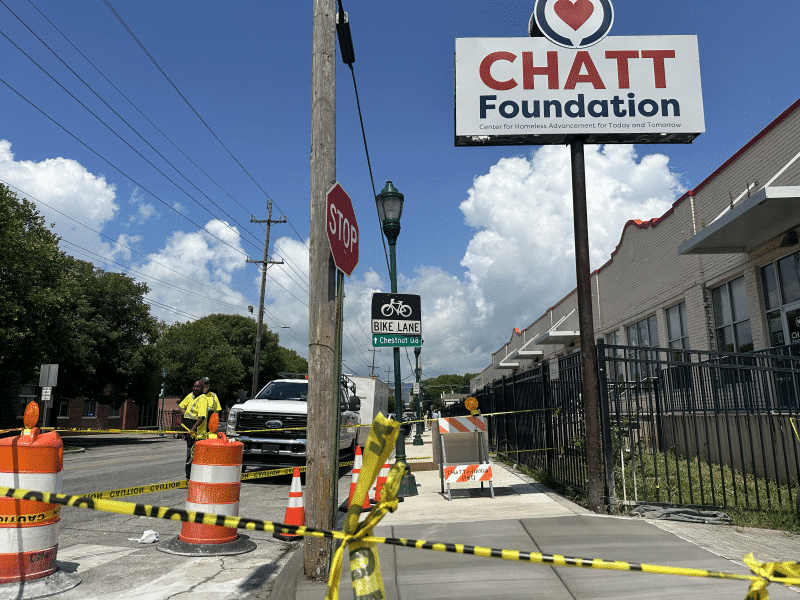
Tree removal exposes unhoused Chattanoogans to summer heat
The city cut down 21 trees outside the Chatt Foundation for an accessible sidewalk. Despite a plan to replace some shade, people are still waiting in the sun.

Chattamatters’ Art in a Minute
Art in a Minute is a segment where we profile artists from all over Hamilton County … in about a minute.
