What your reappraisal means for your tax bill
Property values have gone up, but it’s still up to city and county governments to decide whether tax bills will reflect the increase.

Fast Facts
- Residential property values rose about 59% in Hamilton County since 2021
- Even if your property value went up, your tax bill may or may not increase
- This summer, city and county governments will decide whether to collect additional tax revenue, and if so, how much
Making sense of your reappraisal
Hamilton County residents began receiving notices from the property assessor last month with the most recent appraised value of their property, and every property owner will be notified by the end of May.
On the whole, property values went up significantly — but whether or not taxes go up is still to be determined.
There are two terms to know on your reappraisal notice. The “appraisal,” which is the estimated market value of your property, and the “assessment,” which will be used to calculate your tax bill. By definition, the assessed value equals 25% of the appraisal for residential and farm properties, and 40% of the appraisal for commercial and industrial property.
A ‘really historic’ reappraisal
The reappraisal process happens every four years, allowing local governments to more accurately tax home and business owners. Current assessor Marty Haynes’ office analyzed data on home, business, and land sales as well as visual inspections of the more than 160,000 parcels in the county to update their worth in line with current market values.
In total, property values in Hamilton County increased by about 53%, according to the data Haynes submitted to the state for review in March. Residential property value rose by around 59% countywide.
“ The increases that we’re seeing across the state are really historic right now,” said John Dunn, spokesman for the Tennessee comptroller’s office. “They’re pretty enormous. The market is red hot in Tennessee.”
Will my taxes go up?
A tax increase is not automatic. Reappraisal is the first step, but elected officials still have to decide how much tax bills will reflect the increase in property values.
Why? Because Tennessee requires local governments to adjust their tax rates after a reappraisal. This adjustment, called the “certified tax rate,” makes it so governments would take in the same amount of property tax revenue as the year before a reappraisal.
“ It’s an acknowledgement that this is what the rate should be if we want to not have a tax increase,” Dunn said.
Haynes has yet to determine the certified tax rate for Hamilton County and its 10 cities and towns. Once he does, though, local legislators still have the power to choose a different rate when they set their budgets for the upcoming year.
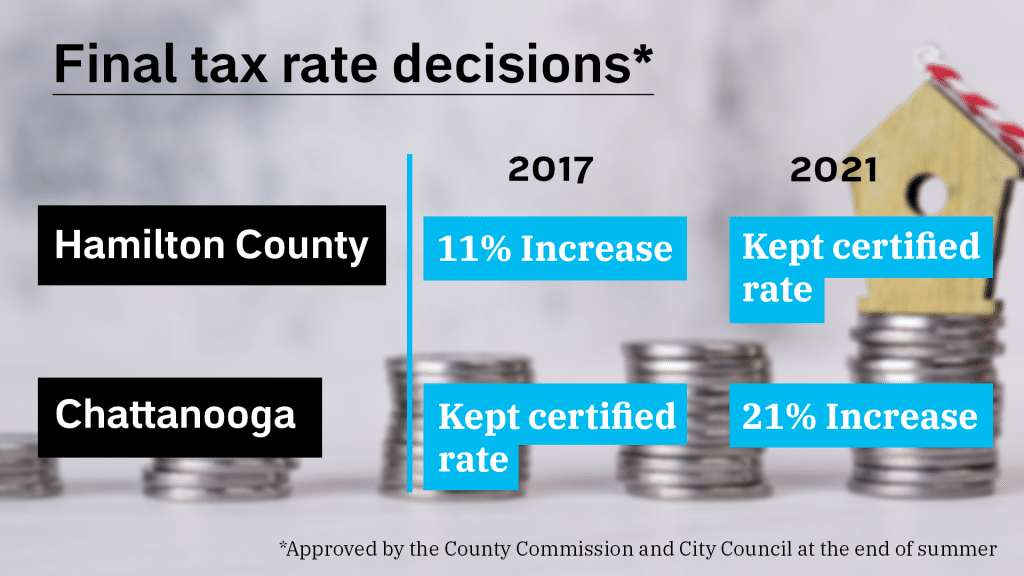
In the past two reappraisal years, 2017 and 2021, Hamilton County and the City of Chattanooga decided on their final tax rates later in the summer.
Eric Holl, advisor to Mayor Tim Kelly, said the mayor’s office will prioritize parks, public transportation, and a pay bump for police officers and firefighters in the coming year. But city officials haven’t finalized a budget proposal amid the property value boom.
“We don’t know yet how much of the growth we need to capture,” Holl said.
County Mayor Weston Wamp has told multiple media outlets he does not intend to raise taxes to fund next year’s budget. A spokesperson from the county mayor’s office told Chattamatters that he has no further update at this time.
See the history of the county’s certified tax rates and subsequent county commission decisions going back to 1988 here.
What if …
The value of my home within Chattanooga city limits has increased by about as much as others in the city and county?
- If both the City of Chattanooga and Hamilton County keep their certified tax rate, your bills won’t change much. If one or both governments raise the tax rate, you’ll owe more.
My home value increased by more than average?
- You’ll have a higher bill unless local governments vote to set next year’s rate below the certified tax rate, which is rare.
When will I know what my tax bill will be?
- May 2025: Haynes’ office must finish issuing reappraisal notices to all property owners
- Late spring and summer: City and county governments hold public budget meetings and release proposed budgets. In the last two reappraisal years, the City of Chattanooga has passed an interim budget in June and adopted a full budget and new tax rate in September. After recent reappraisals, Hamilton County has approved a full budget in June and voted on the tax rate later in the summer. Once tax rates are approved, you can calculate your tax bill.
- Late September: Chattanoogans begin to receive property tax bills from both the city and county.
- October 1 to Feb. 28, 2026: Payment period for Hamilton County and City of Chattanooga property taxes.
Keep an eye out for public meetings to share your thoughts on budget priorities. Those discussions will help you know whether officials need to raise the tax rate to cover proposed costs.
How do I calculate my taxes?
Tennesseans don’t pay taxes on the full appraised value of their property — they’re charged for the assessed value instead. A home’s assessed value is 25% of the appraised value. Businesses are assessed at 40%.
For example, a Chattanooga home appraised at $300,000 has an assessed value of $75,000. Under current tax rates, here’s how the math comes out:
- 2.25% Chattanooga property tax rate — $1,687.50
- 2.2373% Hamilton County rate — $1,677.98
Disagree with your assessment?
Property owners can request an informal review of their reappraisal through this form from the county assessor’s office. Dunn said to “have some evidence” when seeking to adjust a property valuation, such as an independent appraisal.
You can also compare the price of recent home sales near your property here, and search for any county property and its value here.
Anyone unsatisfied with a review can appeal to the Hamilton County Board of Equalization, which will begin hearing cases on June 1. The last day to file an appeal to the local board is June 6.
Author

Related Articles
Connecting Alton Park to the Riverwalk — what’s next?
A new section of the Tennessee Riverwalk is finally in the works, after it took over a decade to secure the funding and land for the project.

Q: How does Chattanooga’s land bank work?
With dozens of vacant tracts in its inventory, the City of Chattanooga has reactivated the land bank to subsidize small-scale affordable development.

The twist in this year’s city budget talks
Without a finalized tax rate, Chattanooga officials must agree on how to pass a budget. After their last budget meeting on May 20, they didn’t.